
Portion Awareness
Mapping Portion Sizes Against the Realities of Home Cooking
Tobias Ashcroft·8 min
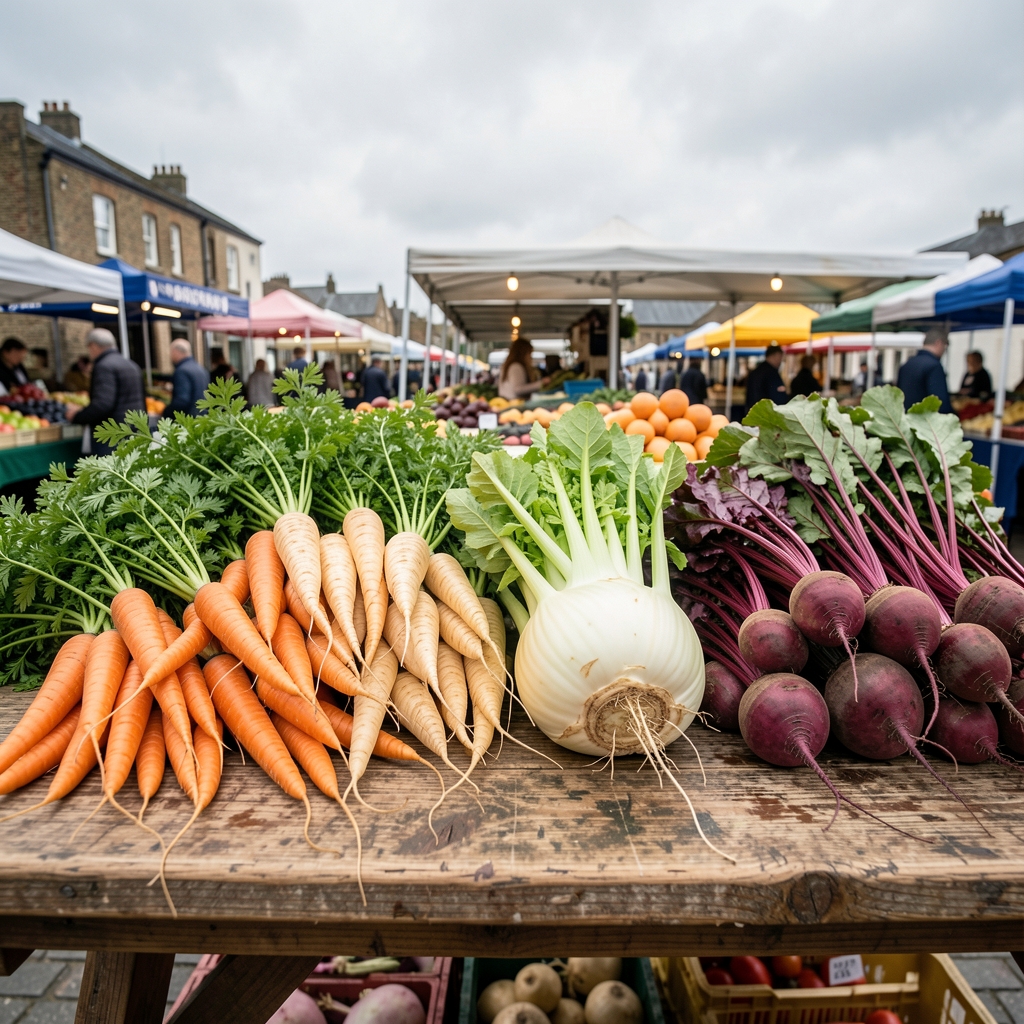
On a Saturday morning in Bloomsbury, the weekly market assembles with a quiet efficiency that most participants take for granted. Root vegetables, dark leafy bundles, and a clutch of late winter brassicas are arranged with the sort of care that suggests someone, somewhere, has thought seriously about what a balanced plate actually demands across the days that follow.
That particular kind of thinking — forward, seasonal, unhurried — sits at the centre of what nutritional researchers have been documenting for some years now: the relationship between how households source their food and the nutritional quality of what eventually reaches the table. Published dietary guidelines issued by the British Nutrition Foundation consistently show that households engaged in intentional weekly planning, including a regular visit to a fresh-produce market or equivalent, tend to maintain a more varied diet across seven days. The mechanism is straightforward: when the week begins with a deliberate assortment of vegetables and legumes rather than a partial shop assembled under time pressure, the subsequent meals draw from a richer and more diverse palette.
For many of the households observed during the research period for this piece, Saturday morning functions as a nutritional anchor point. The purchases made then — the bunch of kale that will need using by Tuesday, the dense whole-grain loaf from the artisan baker, the dried lentils bought in bulk — shape the entire week's eating in ways that Wednesday's exhausted supermarket run simply cannot. Nutritional diversity, measured by the number of distinct plant varieties consumed across a seven-day period, was meaningfully higher in households that treated Saturday shopping as a structured activity rather than a reactive one.
This is not a novel finding. But it is one that tends to be stated in abstractions — "diverse plant intake" and "whole-food dietary patterns" — that do little to help a person standing in front of a market stall with forty minutes before the children need collecting. The practical question is more granular: which categories of whole food, purchased on a Saturday, are most likely to survive the week intact and contribute meaningfully to the meals that emerge from it?
Root vegetables deserve special consideration in this context, because they solve what one might call the midweek problem. By Wednesday and Thursday, the enthusiasm of Saturday has generally dissipated. The leafy greens may be wilting; the fresh fish purchased on a hopeful impulse requires immediate attention. But the carrots, parsnips, celeriac, and beetroots purchased at the weekend remain entirely sound, and are available for roasting, soup, or slow-cooked dishes that require minimal active cooking time. In this sense, roots function as a kind of nutritional infrastructure: dependable, calorie-efficient in their preparation demands, and rich in the dietary fibre that published research links consistently with positive digestive environment and longer-lasting satiety between meals.
Nutritionist Cordelia Marsden, whose published commentary on weekly meal preparation has been cited in several UK dietary education resources, has described the principle in terms that feel practically useful: "The whole-food kitchen needs a backbone, and root vegetables are the most reliable one available. They tolerate delay. They improve with slow heat. And they make the difference between a Thursday that feels like a failure and one that produces a proper meal from what's available."
If roots are the backbone, legumes are the element that most households acknowledge in principle and underuse in practice. Dried lentils and chickpeas, soaked and cooked in batches at the weekend, represent a substantial source of plant protein and soluble fibre that integrates cleanly into a wide range of dishes. A portion of cooked puy lentils added to a Tuesday salad, or a batch of seasoned chickpeas folded into a Thursday grain bowl, requires almost no additional preparation time while substantially improving the nutritional completeness of the meal.
The evidence base for legume consumption as part of a fibre-rich diet is extensive. The published position paper from the British Dietetic Association on plant-based eating patterns describes legumes as one of the most accessible routes to the dietary fibre intake recommended for adults in the UK, which stands at 30 grams per day — a figure that the majority of adults currently fall short of. Beans, lentils, and peas in their whole form contribute to that figure in meaningful increments: a 100-gram portion of cooked chickpeas provides approximately 7 grams of fibre, alongside a useful package of iron, zinc, and folate.
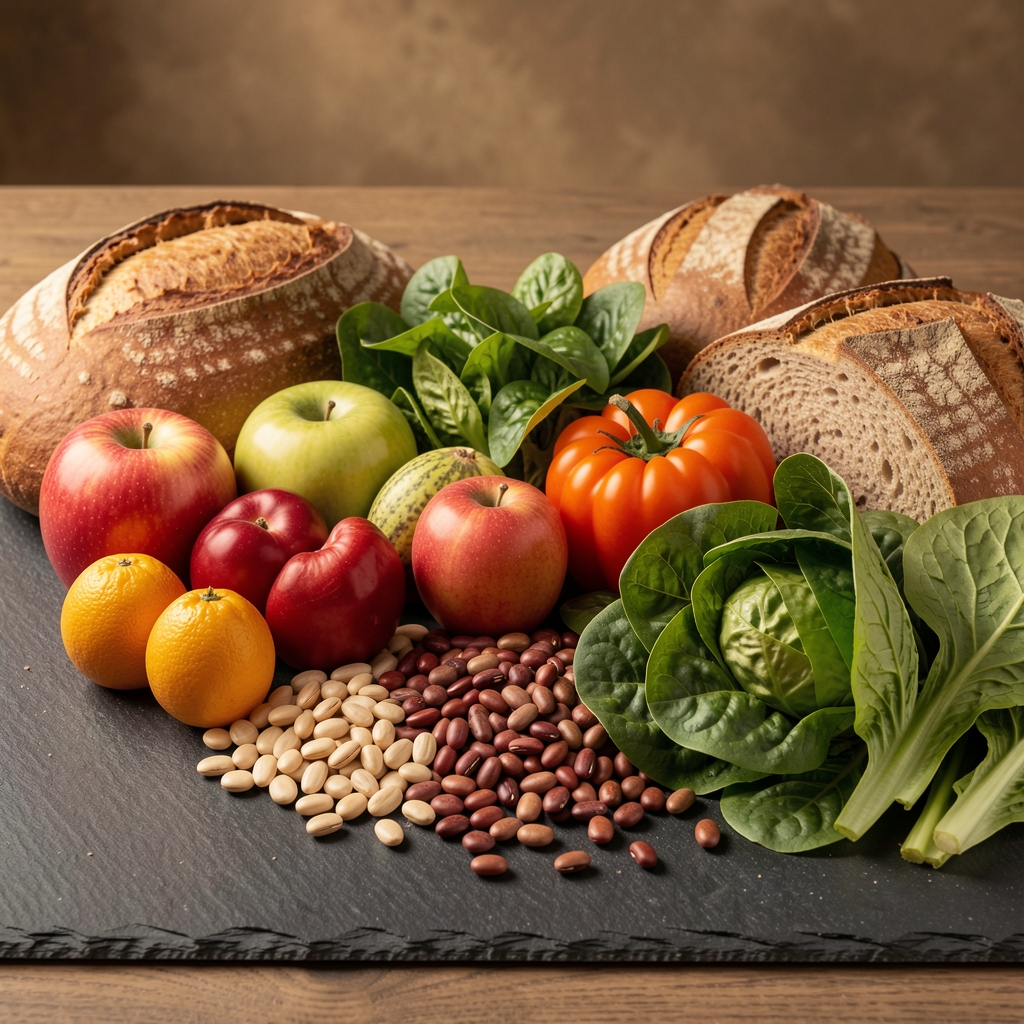
Whole grains occupy the third structural layer of the weekly whole-food kitchen. The difference between white rice and brown, between refined pasta and whole wheat, between a white sandwich loaf and a dense seeded sourdough, is not primarily a matter of calorie content — the caloric differences are modest — but of nutrient density and the satiety profile that follows from consuming a more slowly digested carbohydrate. Whole grains retain the bran and germ layers that milling removes, and those layers carry the majority of the grain's fibre, B vitamins, and trace minerals.
From a calorie awareness perspective, the practical significance is that whole-grain portions generate a more extended sense of fullness, which reduces the likelihood of unplanned eating between meals — one of the more reliable routes to a sustained, gradual approach to body composition management over time. This is the kind of mechanism that translates poorly into short-form dietary advice but becomes visible in the texture of a week that goes well nutritionally: fewer mid-afternoon hunger spikes, fewer compromised choices made under time pressure in the late afternoon, a general sense of the day's energy remaining more level across its hours.
The practical architecture of whole-food eating across a British week tends to rely on one additional element beyond the Saturday shop: a Sunday preparation period. Not an elaborate, multi-hour production — the kind that appears in aspirational food media but does not survive the realistic constraints of most households — but a focused, purposeful 45 to 90 minutes of cooking that establishes the basic components available for the coming week.
A pot of grains on the hob. A tray of root vegetables in the oven. A jar of soaked-and-cooked chickpeas in the fridge. These three elements, prepared simultaneously and stored appropriately, change the character of the weekday kitchen in ways that matter nutritionally. When the raw material is already there — already cooked, already portioned, already awaiting assembly — the barrier to a balanced evening meal drops significantly. The decision fatigue that characterises Wednesday's cooking is not eliminated, but it is substantially reduced: the question shifts from "what can I make from these raw ingredients?" to "how do I assemble what's already prepared?"
Published research on meal preparation behaviour, including a 2023 observational study cited by the European Journal of Nutrition, found that households engaged in regular advance preparation consumed significantly more vegetables and legumes across the week than households that did not, and reported meaningfully lower rates of reliance on processed convenience foods. The preparation habit, in other words, functions as a structural support for the dietary intentions that most people hold in principle but struggle to maintain under the pressure of a full working week.
The final element worth noting in this particular observation of whole-food eating across a British week is the role of seasonal alignment. The January and February kitchen in the UK operates under constraints that the June or July kitchen does not — and the households that navigate this most successfully tend to be those that have, consciously or not, adapted their expectations to fit the season. The expectation in winter is not a salad; it is a soup, a roast, a grain bowl with dark leaves and deeply roasted roots. The nutritional quality of these dishes, when constructed from whole-food components sourced in season, is entirely consistent with the broader dietary goals of variety, fibre density, and sustained energy. The season does not reduce the ambition; it redirects it.
Oravelin Quarterly operates under the following editorial principles: articles are reviewed by at least one second editor before publication, sources are cited where appropriate, corrections are noted publicly, and writers disclose any commercial relationships that could influence their selection of subject matter. Eleanor Whitfield declares no commercial relationships relevant to this piece.
Articles published on Oravelin Quarterly are editorial in nature and reflect the writers' observations on everyday wellness practices. The content is not intended as professional advice, nor as guidance for the management of any specific condition. Readers with specific concerns about their daily routines are encouraged to speak with a qualified wellness professional.

Eleanor Whitfield is the editor-in-chief of Oravelin Quarterly. Her editorial focus is on everyday nutrition practice, seasonal eating, and the intersection of food culture with evidence-based dietary guidance. She holds a postgraduate qualification in nutritional communication.
More from Oravelin Quarterly →